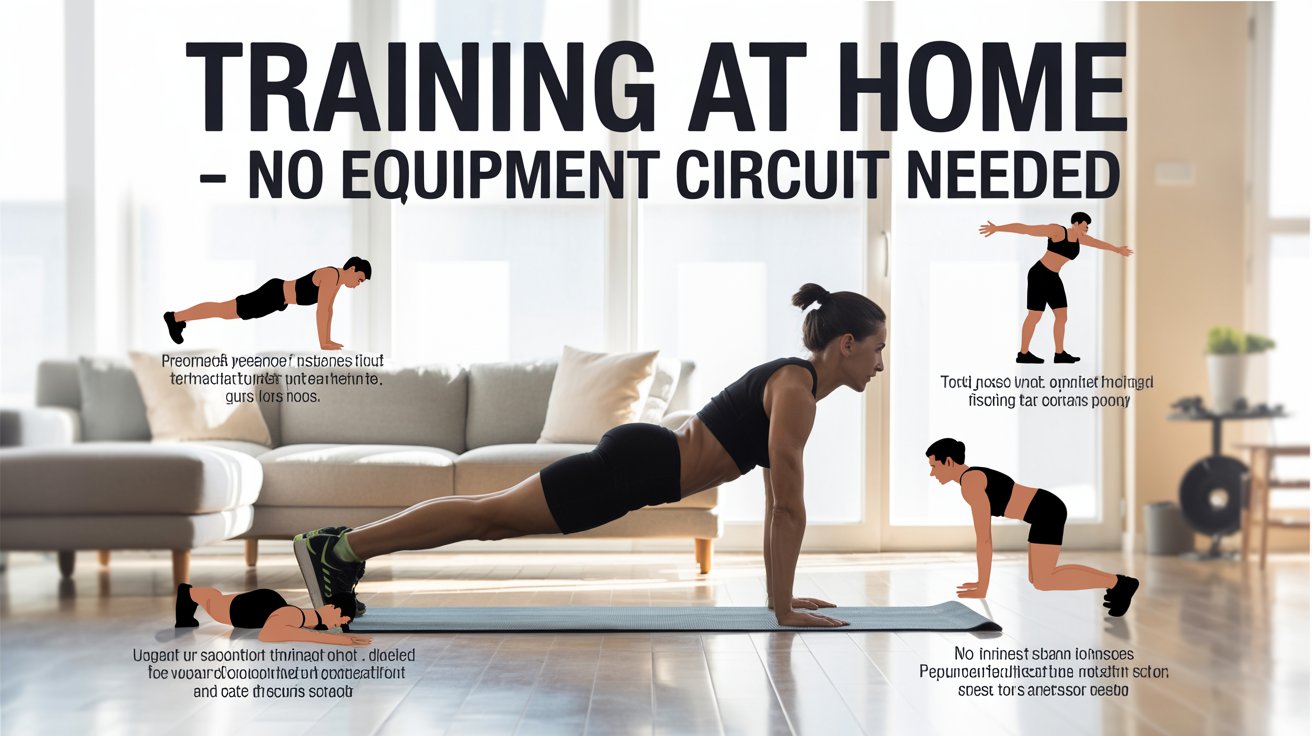
What are the benefits of circuit training?
eatenand increase your metabolism.Training At Home – No Equipment Circuit Needed And if you normally strength train, this circuit training willhigh-intensity trainingWith only your own body weight. We can’t emphasize this enough: circuit training has something for everyone!
Another advantage of circuit training is that it oftenlittle equipment, but still the necessary intensityCircuit training is made up of compound exercises, meaning that the movements require the activation of multiple muscle groups. Instead of isolating individual muscles, as in traditional strength training, compound situation!
Need more proof that circuit training is the answer? Studies have shown that interval training can help.Burn fatIf fat burning is one of your goals, try incorporating this at-home circuit training routine into your workout routine a few times a week.
What do you need?
The following full-body at-home workout focuses primarily on strength training, but you’ll also burn calories—all without any equipment.All you need is a little…Living spaceIa chairfor triceps exercises. If you are exercising on a hard surface,an exercise or yoga matcan also be useful for supporting your knees and forearms.
Circuit training at home?
This training includes:eight exercisesThis will challenge your entire body. Rest about 20 seconds between exercises. If you want to repeat this workout in the same workout, we recommend resting a full minute between sets. You can use dumbbells for the squats, but that’s completely optional, and you’re moving so fast that the weights will only slow you down.
Push-ups?
We don’t want to make this circuit easy for you! Push-ups are a great way to start, as they warm up every muscle in your body while providing a challenge. Training At Home – No Equipment Circuit Needed Challenge yourself with a traditional starting position on the floor, but bend your knees if necessary! Good posture is key. If your posture is shaky, try doing push-ups on your knees.
Burpees?
Get ready to sweat, because now it’s time to move on to burpees. Although the push-up portion of this exercise is optional, adding it will help you get the most out of this at-home workout. Take the reps slowly and do the push-ups on your knees. For a less impactful variation, you can skip the jumps.
Planks?
This plank exercise gives your arms an extra challenge while strengthening your core. Your starting position can be a high or low plank on the floor, depending on your preference.Training At Home – No Equipment Circuit Needed To modify this exercise, bend your knees. You can also do a side plank and switch sides after 30 seconds. For an even more challenging exercise, try lifting one leg at a time. You won’t be able to lift your legs very high, but even if you lift each foot a few inches, your core will still be tight!
Outcome with hope?
Jump lunges are a great lower body workout that also gets your heart rate up. Start by standing on the floor with your right leg in front of you, your left leg behind you, and your right knee bent at a 90-degree angle. Jump up with both legs and land with your left foot in front of you and your right foot behind you. You can land with your legs straight or bent, depending on your fitness level. Return to the lunge position and repeat. If you’re too tired, you can also do traditional lunges, where you step forward or backward with your right leg and then switch sides.
Push-ups with dolphins?
Dolphin push-ups challenge your core and work your leg and shoulder muscles in a unique way. While it may be tempting to push off the floor with your feet, make sure your legs are straight and stable to get the most out of this exercise. Your knees can be slightly bent, but try to keep them straight and stable as well. Dolphin push-ups can be challenging, so feel free to switch to regular push-ups if you can’t maintain proper form.
Biceps squat?
Frog squats are another fun, animal-inspired exercise that really works your hips. Your hips should be very low and close to the floor in the starting position, just like in a squat. Then, lift your hips up to the normal squat starting position, keeping them in line with your knees. Be prepared for some sharp pain, as your leg muscles will be engaged throughout this circuit.
Trizeps-dips?
Almost done! Tricep dips are a great resistance exercise for your upper body. To perform them, stand on a chair or coffee table and start with your back against the chair. Place both palms on the edge of the chair and your feet on the floor. Keep your knees straight as you lift and lower your body with your arms. If possible, try to bring your hips toward the floor. Even if you only bring your body a few inches closer to the floor, you will see progress after a few weeks of this circuit training Sitting on tat home.
he wall?
Now we’re back to working the lower body with an old-fashioned exercise. Proper posture is crucial to getting the most out of this exercise. So make sure your feet are flat on the floor and your knees are bent at a 90-degree angle. We recommend one minute, but see how long you can do it! If wall sitting isn’t your thing, you can do this circuit workout with 15 squats.
New to circuit trainingTry this workout and see how it feels. It’s quite challenging, but remember: it only makes you stronger! If you still have enough energy for another round, go for it! For advanced users who want to complete a full workout, we recommend doing this workout three times.
Can you exercise at home without equipment by performing yoga poses?
Home training with a focus on bodyweight exercises is an effective way to build strength and muscle mass, improve aerobic fitness, and control fat mass.
If the gym isn’t your thing or you’re short on time, you can quickly clear a spot in a room and get started.
This article outlines 30 bodyweight exercises that are suitable for beginners, intermediate, and advanced lifters. Start with what you feel ready for and work your way up from there.

Intermediate routine?
Once you master the beginner routine, you’re ready to try these advanced moves.
Do two sets of 10 to 15 repetitions of each of the exercises listed below, then rest for one minute before moving on to the next exercise.
An alternative, more advanced approach is to perform rounds with a time limit. For example, perform each exercise for one minute and repeat the round twice.
Challenge yourself to do just one or two more reps each workout. But don’t sacrifice proper form for extra reps. It’s better to do fewer reps and maintain proper form to reduce the risk of injury.
Pike push-ups?
Adding a push-up to your pike exercise will further stress your shoulders. The movement here is entirely in your arms, so keep the rest of your body stable.
Perform the exercise by assuming a diagonal position and bending your elbows, extending them out to the sides and pointing the top of your head towards the floor.
Plank with alternating leg lifts?
Adding a leg lift to a regular plank creates instability. Your core has to work extra hard, and your three limbs have to bear more weight.
Lift one leg, hold for 5 seconds, then lower it. Repeat with the other leg.
Squats above your head?
Stretching your arms overhead challenges your upper body flexibility and range of motion, while your lower body benefits from squats. You also work your core muscles.
The daily 4-minute thigh workout?
One of the biggest misconceptions about exercise is that you have to put in hours every day to see results. We’re busy women, so if we can get more bang for our buck with short workouts, sign up!
Here’s a four-minute thigh workout you can do daily. But don’t be fooled: Just because it’s short doesn’t mean it has to be easy. Quality over quantity. So focus on proper form, add a dumbbell if bodyweight is too light for you, and get going.
Enbent bro?
No leg workout is complete without a bridge.Training At Home – No Equipment Circuit Needed It strengthens your hamstrings, glutes, and core. To get the most out of this exercise, squeeze your glutes as you reach the top and build a real mind-body connection.
How do you get into a routine?
There are countless options for bodyweight training. Below are some exercises you can try. While they are great if you have time for a full workout, the beauty of these exercises is that you can also do them in a short session.
Try doing some exercises while you’re at the office and taking a short break. Or multitask and do some exercises while applying a hair mask or face mask.
Let these routines take care of your thoughts for you, especially on days when your mind is completely occupied.
Try to do these exercises several times a week for about 15 to 20 minutes a day. Make sure you have at least a full day of rest between sessions.
Do you do yoga or stretch regularly?
Restorative yoga poses are a great way to relax your body. Hold each pose for three to five minutes to stretch and regenerate your connective tissue.
Focus on releasing tension to go deeper into these positions. Options include legs up the wall, head to knees, and lying butterfly.
Yoga Nidra is a guided meditation technique performed while lying down. Just sit back, listen, and experience the beneficial effects, including full-body relaxation. Yoga Nidra sessions are available.
Do something relaxing?
Take time to relax your body and mind. Stress leads to tension and stiffness in the body. So set aside time each week for an activity that calms you down. Think about a walk in nature, a relaxing bath, or dancing.
Do you remember the benefits of exercise?
Whether you’re doing bodyweight exercises, going for a walk, dancing for your cardio, or stretching regularly, remember the reasons you want to do it. And take small steps to stay motivated. All of these benefits apply to exercise in general as well. Regular exercise also improves your energy levels, mood, and overall well-being, allowing you to maintain and improve your routine.
What is the conclusion?
As always, it’s important to set goals and develop a plan to achieve them. Start small, and hopefully over time you’ll see positive results from your efforts and be encouraged by them.
Remember, if you’re short on time, you can also do a partial workout. Increase your workout slowly, listen to your body, and do what works best for you on any given day. Consult your doctor if you’re taking medications or have any health conditions that could affect your workout.
Hanging knee lift?
These hanging knee raises work your entire transverse abdominis, the muscles that keep your stomach flat and toned.
In addition to working your core muscles, this hanging knee raise also targets your hip flexors, shoulders, latissimus dorsi, and biceps.