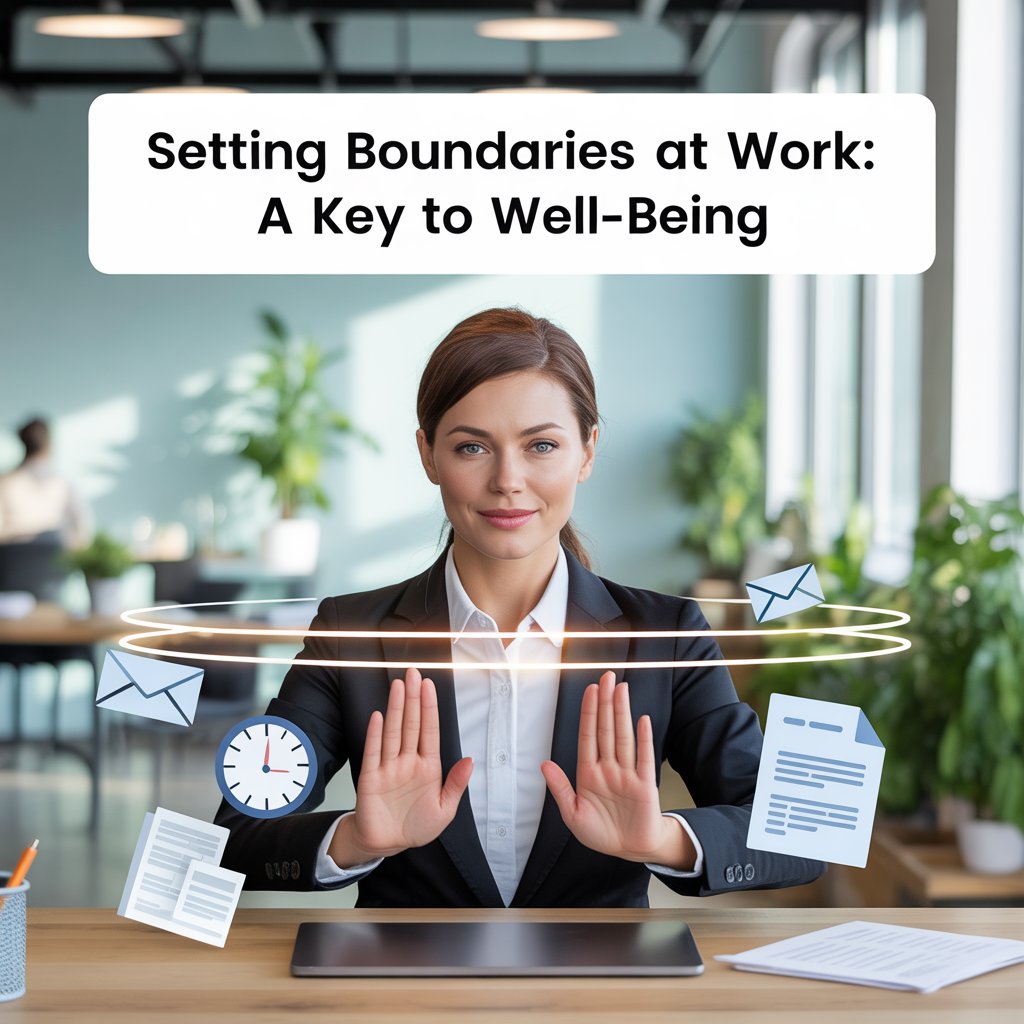
Why is it important to set boundaries at work?
Before you consider your behavior as an employee, think about the person who shows up at work. A good work-life balance starts with prioritizing yourself and what’s important to you.Setting boundaries at work: a key to well-being. Boundaries are crucial to maintaining this balance.
As a manager or leader, setting boundaries in the workplace helps you engage with your team in a resourceful, respectful, creative, and supportive way. This creates a work culture that employees want to stay in. Setting boundaries frees you up to take care of your mental health, which increases job satisfaction, morale, and a sense of belonging.
What are the main benefits of boundaries in the workplace?
By setting limits on the amount of work, the type of tasks, and the hours you work, you can better manage your workload and avoid feelings of being overwhelmed.
Setting boundaries in the workplace allows you to focus on tasks that align with your role and responsibilities.Setting boundaries at work: a key to well-being. Boundaries allow you to prioritize effectively, focus on important tasks, and avoid distractions or unnecessary requests.
Clearly communicating your work boundaries demonstrates professionalism and self-respect. This encourages your colleagues to treat you with respect and recognize your needs and boundaries. This leads to a healthier working relationship.
Setting boundaries requires self-confidence and assertiveness. Learning to set boundaries at work can lead to personal growth because you can express your needs with greater confidence.
Why are boundaries important for your mental health?
Not everyone has the same boundaries. Most people can’t guess other people’s boundaries.Setting boundaries at work: a key to well-being. By setting clear boundaries at work and in your relationships, you ensure that your needs are met. Boundaries help us maintain balance and promote healthy relationships.
Healthy relationships should be mutually beneficial and positive. Let’s say you feel like you’re putting in more effort, or your efforts aren’t being reciprocated by a friend. Your relationship could benefit from a conversation about boundaries.
Maintaining professional boundaries between work and personal life can contribute to success. A healthy work-life balance also protects your mental health. A good example of such a boundary in the workplace is clearly stating your work hours in an email signature. This lets others know when they can expect a response and when they can’t. Another example of such a boundary is clearly stating your expectations of your manager regarding prioritizing tasks.
How do you set boundaries?
Saying no is often uncomfortable. Setting boundaries at work: a key to well-being.But when you say no, you’re actually saying yes to yourself. That could mean taking time for yourself, quality time with loved ones, or projects you’re already invested in. How you set boundaries can help you stick to them better in the long run.
Boundaries don’t set themselves. When you cross a boundary, communicate your needs clearly and respectfully. Boundaries can evolve and change, just like relationships. Take time to reflect on your boundaries and adjust them as needed.
Remember: It’s important to maintain your boundaries. But also make sure to respect the boundaries of others.
The essence of boundary setting is respect. Respect yourself and your relationships enough to understand and clearly communicate your needs. This will make you feel better and better.
Cognitive behavioral therapy?
Cognitive behavioral therapy (CBT) is the most common treatment method.Setting boundaries at work: a key to well-being. This therapy focuses on the effects of anxious thought patterns on your emotions, behaviors, and relationships.
Some of our thought patterns can be unfavorable, and we often don’t notice them. They are often exaggerated and unrealistic. However, they significantly affect our emotions and can worsen anxiety. These negative thought patterns are often called cognitive distortions.
Acceptance and commitment therapy?
Acceptance and Commitment Therapy (ACT) helps you become more psychologically flexible.Setting boundaries at work: a key to well-being. A therapist who uses this method can help you accept thoughts and feelings as they arise and learn to stop controlling them. Acceptance and Commitment Therapy also emphasizes identifying personal values and putting them into action. This is used as a healthier way to deal with unpleasant feelings of anxiety.
Some examples of exercises in this type of therapy include: These exercises can help you accept and let go of negative thoughts and feelings instead of trying to control or avoid them. By identifying your values and applying them to your daily life, you can realize that unpleasant thoughts and fears can come and go and that they don’t have to affect your personality.
Interpersonal therapy?
Interpersonal therapy is about maintaining relationships with others and addressing personal challenges that can trigger anxiety.
Personal challenges that cause stress, anxiety, and other intense emotions include: life changes, stressful relationships, and social challenges.
A therapist using this method can help people deal with a fearful or challenging situation in a healthy way. This can help reduce the feelings and anxiety the situation causes and enable them to develop a healthy mindset and positive behavior in the future.
What questions can you ask your therapist?
Getting to know your therapist is just as important as being introduced to them. Ask questions to see if they are a good fit for you. Sometimes it can be difficult to find the right questions to ask during an initial therapy session. Therapy is most successful when you find a therapist who is a good fit for you. You should find someone who has experience treating others with similar issues and whose personality or approach appeals to you. You may find that the first therapist you meet is a good fit, but it is also common to see several therapists before you find the right one.
What is telemedicine etiquette?
For a video healthcare visit, it is best to activate the camera feature on your device. This will make it easier for your doctor to see and communicate with you. It is best if you are not distracted during the visit and do not need to drive. It is best to find a private place where you can discuss your medical history and any current concerns.
Feel free to ask questions. No question is too obvious or too bad.
Mindfulness techniques for managing anxiety?
We can cling to stressful or worrying thoughts that can make us anxious. You can practice controlling these anxious thoughts.
Imagine a street with a stream of cars driving by. Some cars move so slowly and quietly that you barely notice them. Others, on the other hand, are loud, fast, and honking, making them immediately noticeable. We pay more attention to these cars because they are so disruptive.
Our thoughts flow like cars on the road. Imagine each thought as a passing car. Some thoughts are quiet and unnoticed. Others are loud and intrusive. They often catch our attention and make us nervous. When one of these intrusive thoughts comes up, practice letting it pass unnoticed, as if it were just a noisy car on the road. Simply notice it as it passes by, and eventually it will become a blurry, distant image.
Do you give your fear a name or a face?
Giving your fear a name can help you deal with it better when it arises.
You can also give fear a face or shape to help you deal with this feeling. You can create a picture in your mind and visualize it when you feel afraid. If you enjoy artistic work, you can even draw, paint, or sculpt what fear looks like to you.
Giving fear a name and a face helps you separate yourself from it. Giving it a name and a face also helps you change your relationship with fear and better manage it when it rears its ugly head.
Foundational techniques for dealing with fear?
Anxiety only manifests in the mind. It also manifests physically through symptoms such as chest tightness or muscle tension. Grounding techniques can calm the body and mind. They help manage the physical symptoms of anxiety, which can be just as uncomfortable as the anxious thoughts. The beauty of grounding techniques is that they can be used anywhere, anytime.
What is an anxiety disorder?
Anxiety is a feeling of fear or discomfort. It can help you cope with stress and even motivate you to concentrate.
However, there are also situations where anxiety does not go away. It can worsen over time and interfere with everyday activities. It is a condition that can benefit from specific treatments.
Does fear affect your life?
If your anxiety is bothersome but doesn’t interfere with your life, it’s probably not an anxiety disorder. However, if your anxiety interferes with your important activities, it’s more likely an anxiety disorder.
Is it normal to feel fear in a certain situation?
People often feel fear in stressful or risky situations. In people with anxiety disorders, the fear is disproportionate to the risk or danger.
People with anxiety disorders often find that their reactions are exaggerated and too intense. But getting anxiety under control is not easy.
If your anxiety symptoms are severe or affecting your life, you should see a doctor.
What is the difference between anxiety and fear?
Fear is something that everyone experiences. It is a normal reaction to a threat. Fear affects the five senses: sight, hearing, smell, taste, and touch. These senses send information to our brain that triggers a fear reaction.
Fear is not a real danger, but a reaction to our emotions. It is often caused by something from the past that still affects us.
How is anxiety diagnosed?
To diagnose an anxiety disorder, a doctor will ask you questions and review your medical history. They will also discuss your specific pattern of anxiety symptoms. It is important to be honest about your symptoms and how they affect your life.
There is no laboratory test to diagnose an anxiety disorder. However, your doctor may perform tests to rule out other conditions that can cause similar symptoms.
Your doctor may recommend that you consult a mental health professional, such as a psychiatrist or psychologist. They have access to additional tools and tests that can help with the diagnosis.
What can you do to reduce your fears?
Important in the fight against anxiety. Research has shown that many activities help reduce stress reactions. Yoga, chi, and many others can reduce anxiety.
It’s also important to fight your fears. Avoiding things that trigger your anxiety can increase and even worsen it.
Some treatments for anxiety don’t focus on avoiding triggers, but rather on exposing yourself to the anxiety-provoking factors as much as possible. By gradually exposing yourself to the trigger, the brain learns not to react.
Medications for anxiety disorders?
The most common medications are those that are not used exclusively to treat depression. In fact, most antidepressants work just as well (or better) for anxiety disorders as they do for depression. Antidepressants can relieve some anxiety symptoms.
Many people are prescribed it for panic attacks. However, this medication is not used for generalized anxiety disorder because it can easily lead to addiction.