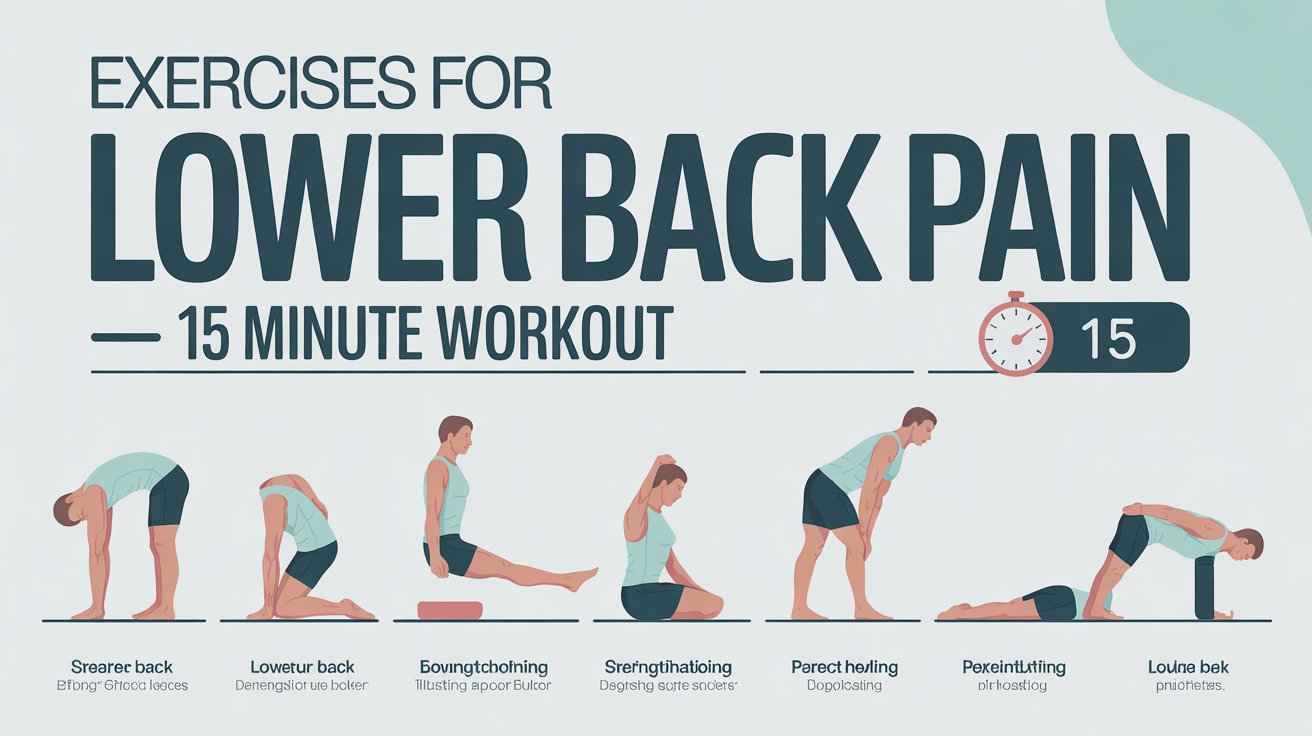
Start slowly and increase gradually?
If you can’t do certain exercises, focus on the exercises you can do. The for Lower Back Minute Workout is designed to help you start gently and build strength over time.If you can’t do certain exercises, focus on the exercises you can do. The Exercises for Lower Back Pain – 15 Minute Workout is designed to help you start gently and build strength over time. As the exercises become easier, you can gradually increase the number of exercises and the number of repetitions during each session.
Tip: These exercises are best done on a yoga mat on a hard floor. Don’t have a yoga mat? Try them on a regular mat for comfort and support. As the exercises become easier, you can gradually increase the number of exercises and the number of repetitions during each session.
Tip: These exercises are best done on a yoga mat on a hard floor. Don’t have a yoga mat? Try them on a regular mat for comfort and support.
Trunk rotation while sitting?
If you can stand comfortably, skip this exercise and start with the following standing torso rotation.
- Find a sturdy chair, such as a dining room chair.
- Sit slightly leaning forward so that your back is not resting against the chair. Keep your legs bent at the knees at a 90-degree angle and shoulder-width apart.
- Cross your arms in front of your chest.
- Make sure your hips are always pointing forward.
- Slowly turn to the right (as far as is comfortable) and then return to your face.
- Slowly turn to the left (as far as is comfortable) and then return to your face.
Trunk rotation in a standing position?
- Stand straight with your legs slightly apart and your knees slightly bent.
- Cross your arms in front of your chest.
- Make sure your hips are always pointing forward.
- Slowly turn to the right (as far as is comfortable) and then return to your face.
- Slowly turn to the left (as far as is comfortable) and then return to your face. Repeat the movement 10 times on each side.
High knees?
- Stand straight with your legs slightly apart.
- Slowly raise your right knee to a 90-degree angle (or as high as possible), then slowly lower it back down to the floor.
- Slowly raise your left knee to a 90-degree angle (or as high as possible), then slowly lower it back down to the floor.
- Repeat the movement 10 times with each leg.
Tip: If you have difficulty maintaining your balance, hold on to the back of a chair or countertop. Ask a friend or family member nearby if you need additional help.
Standing side bends?

- Stand straight with your feet shoulder-width apart.
- Place your arms next to your body.
- Keeping your body in a straight line, slowly lower it to the right and slide your hand down your leg towards your knee.
- Stretch as far as is comfortable for you.
- Slowly come back up and repeat the exercise on the left side.
- Repeat the movement 10 times on each side.
Stretch your back when standing?
Do not attempt this if you are concerned about your balance.
- Stand straight with your feet shoulder-width apart.
- Slowly bend forward and round your back towards the ceiling. Lower your shoulders and stretch your fingers towards the floor.
- Relax your back muscles so that your upper body appears to be dangling downwards.
- Slowly come back up until you are standing upright.
- Repeat this five times.
How should I feel when I exercise?
Perform the movement until you feel a slight pull in the muscles.If you can’t do certain exercises, focus on the exercises you can do. The Exercises for Lower Back Pain – 15 Minute Workout is designed to help you start gently and build strength over time. As the exercises become easier, you can gradually increase the number of exercises and the number of repetitions during each session.
Tip: These exercises are best done on a yoga mat on a hard floor. Don’t have a yoga mat? Try them on a regular mat for comfort and support. If you feel pain, stop immediately. Severe pain is a sign that you have gone too far or that something is wrong.
During these exercises, it is important to activate your core. To do this, pull your navel up and towards your spine. You should feel the muscles between your hips tighten and be able to breathe normally again.
You may notice that your muscles become tired during the exercises. This is a sign that they have been trained well. It is normal to experience some muscle soreness the next day. Give yourself time to recover before repeating the exercises. However, if the exercises make your pain worse, consult your doctor.
Tip: Do not hold your breath during the exercises. It is important to breathe consistently throughout the movement.
Many lower back exercises are floor exercises. If you experience dizziness or a feeling of unsteadiness when standing up after sitting or lying down for a long time, or after bending over (orthopedic hypotension), these exercises may not be suitable for you.
Stretching exercises for back pain
Sitting cat-cow?
- Find a sturdy chair without armrests, such as a dining room chair.
- Sit upright, 10 to 15 cm from the back of the chair, with your legs bent at a 90-degree angle, feet slightly apart on the floor, and hands on your thighs.
- As you exhale, bend forward and slowly round your back. Pull your stomach in, lower your chin to your chest, and bring your hands toward and beyond your knees.
- Hold this position for one to two seconds and then do a reverse movement.
- Inhale slowly and sit up straight again. Arch your back, push your stomach forwarddand look at the ceiling. Bring your hands up and your thighs closer to your body.
- Hold this position for one to two seconds and repeat from the beginning.
Cat-you?
- Stand on all fours and place your hands flat on the floor.
- Place your arms directly under your shoulders, with your knees directly under your hips.
- Inhale as you lower your stomach to the floor, arch your back, and look up at the ceiling.
- Hold this position for one to two seconds and then do a reverse movement.
- Exhale as you pull your navel back, arch your back, and lower your head toward the floor.
Knee rolls?
- Exhale and slowly roll both knees to the right, keeping your legs and feet together.
- Hold this position for one to two seconds.
- Inhale and slowly bring your knees back to center.
- Repeat this on the left side.
Upward dog?
- Lie on your stomach with your face down and your legs extended.
- Place your hands on the floor next to your chest and next to your lower ribs.
- Take a deep breath and tighten your core (by pulling your navel up and towards your back).
- Exhale slowly for three to five seconds while pressing your hands into the floor and extending your arms, lifting your head, neck, and back.
- Try to keep your hips on the floor.
- Inhale and lower yourself towards the floor with bent arms.
Knee hugs?
- Lie on your back with your legs extended.
- Pull both knees towards your chest.
- Grab your knees with both hands and slowly pull them towards your chest (like a hug) and exhale.
- Hold this position for five seconds.
- Release your hands, inhale, and lower your legs back to the floor, keeping them straight.
Good morning, are you sitting?
- Find a sturdy chair without armrests, such as a dining room chair.
- Sit upright, bend your legs at a 90-degree angle, and place your feet slightly wider than shoulder-width apart, if this is possible without discomfort.
- Place your arms between your legs.
- Slowly lower your hands to the floor, keeping your back straight and bending your hips.
- Lower yourself as far as you can without causing pain or arching your back.
- Sit up slowly and keep your back straight the whole time.
Good morning?
- Stand straight with your feet shoulder-width apart.
- Place your fingers on your temples and extend your elbows outward.
- Tighten your core (by pulling your belly button up and towards your back).
- Bend your knees slightly, bend at the hips, and lower your upper body forward. Keep your back straight the entire time.
- Bend your knees as far as possible, but keep your back straight. Try to straighten up (so that your body is parallel to the floor).
- Stand up slowly again, keeping your back straight.
- Inhale as you lower yourself down and exhale as you come back up.
Pelvic lift?
- Lie on your back with your knees bent and your arms hanging at your sides.
- Take a deep breath.
- As you exhale, tighten your core (by pulling your navel up and toward your back) and tighten your glutes.
- Hold this position for one to two seconds.
- Inhale and gently lower yourself down to the floor.
Standing trunk rotation with arms extended?
- Stand straight with your legs slightly apart.
- Tighten your core (by pulling your belly button up and towards your back).
- Extend your arms out in front of you with your hands clasped at shoulder height or at a height that is comfortable for you.
- Make sure your hips are always pointing forward.
- Slowly turn to the right (as far as is comfortable) and then return to your face.
- Slowly turn to the left (as far as is comfortable) and then return to your face.
- Twist only as far as is comfortable. You should feel a slight tension in your muscles.
Superman?
Exhale and slowly lift your arms, shoulders, and legs off the floor, tightening your glutes.
- Inhale and slowly lower your body back to the floor.
If you have difficulty keeping your arms straight, place your fingers on your temples and point your elbows outward.
What is a high shelf?
A high plank is similar to a forearm plank, but your palms (instead of your forearms) act as support for your upper body.If you can’t do certain exercises, focus on the exercises you can do. The Exercises for Lower Back Pain – 15 Minute Workout is designed to help you start gently and build strength over time. As the exercises become easier, you can gradually increase the number of exercises and the number of repetitions during each session.
Tip: These exercises are best done on a yoga mat on a hard floor. Don’t have a yoga mat? Try them on a regular mat for comfort and support. Once you are familiar with the starting position,
Here’s how to perform a high plank perfectly, according to Emma:
- Start in a tabletop position on your hands and knees with your hands on the floor directly under your shoulders and fingers apart for stability.
- Extend your legs back, one at a time, to lift your knees off the floor and into a high plank position.If you can’t do certain exercises, focus on the exercises you can do. The Exercises for Lower Back Pain – 15 Minute Workout is designed to help you start gently and build strength over time. As the exercises become easier, you can gradually increase the number of exercises and the number of repetitions during each session.
- Tip: These exercises are best done on a yoga mat on a hard floor. Don’t have a yoga mat? Try them on a regular mat for comfort and support. Your toes should be flexed and your feet together, with your body in a straight line from head to heels. Avoid letting your hips hang too far or lifting too high. Brace your glutes, press into your palms, and remember to pull your shoulder blades back and down. To ensure you’re engaging your core, gently pull your belly button toward your spine. Keep your neck in a neutral position by looking slightly forward over your hands.
What muscles do you train with high planks?
A high plank activates the core muscles while also working the arms.If you can’t do certain exercises, focus on the exercises you can do. The Exercises for Lower Back Pain – 15 Minute Workout is designed to help you start gently and build strength over time. As the exercises become easier, you can gradually increase the number of exercises and the number of repetitions during each session.
Tip: These exercises are best done on a yoga mat on a hard floor. Don’t have a yoga mat? Try them on a regular mat for comfort and support. shoulders, and chest, says Emma showed greater muscle) activity in their lower trapezius muscles and triceps muscles when performing variations of the high plank than when performing variations of the forearm plank.
With this in mind, Carpenter says the high plank is the better option for anyone looking to develop their full-body coordination and functional strength.
Plank vs. high plank: Which is best for you?
For the record: You don’t do that.If you can’t do certain exercises, focus on the exercises you can do. The Exercises for Lower Back Pain – 15 Minute Workout is designed to help you start gently and build strength over time. As the exercises become easier, you can gradually increase the number of exercises and the number of repetitions during each session.
Tip: These exercises are best done on a yoga mat on a hard floor. Don’t have a yoga mat? Try them on a regular mat for comfort and support. You can choose between the two. You can use both high planks and forearm planks in the same routine and even the same workout.
While both planks offer similar benefits, there may be different reasons why you might choose one over the other. For example, if you have sensitive wrists, the forearm plank is less risky. This variation is especially beneficial for people with unstable or restless wrists, as it eliminates direct pressure on the hands and focuses more on core activation, says Carpenter. As mentioned, forearm planks are great if you’re prioritizing your core, while high planks are better for activating your shoulder and upper back muscles.
You can also choose between a high plank or a forearm plank, depending on how the exercise fits into your workout.